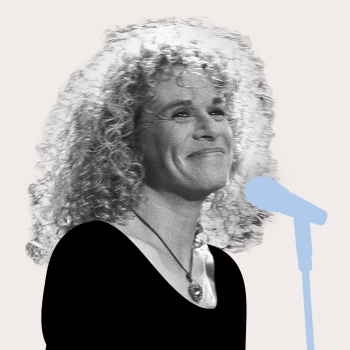
To stratify the 400-song catalog of Carole King, let alone choose her shiniest song, is an exercise in foolishness. It’s impossible, yet there is that pull for one tune to be the fullest, most heartbreaking, most illustrative of her totality. And the finest song of King’s career may just be “Way Over Yonder.” It has been described as expressing a desire for peace and homecoming, but is more truly the soundtrack to a home-going — one of the most rhapsodic descriptions of heaven’s terrain in the history of American pop.
There’s the “shelter from a hunger and cold.” There’s the easy embodiment of, and escape from, trouble and worry. There is the glory of knowing exactly where you are bound. The through line in King’s work is the way she isolates near-unnameable feelings and then charts them plainly.
In the early 1960s, King and her first husband, Gerry Goffin, were among the writers whittling songs to perfection as part of the Brill Building era. The United States was still segregated by law and custom, but the Brill scene often operated by a different logic — one where some Black and white artists, men and women, made music that crossed lines imposed by the prevailing social order.
So many of the songs that King wrote in this period — the Shirelles’ 1960 hit “Will You Love Me Tomorrow” (the first song by a Black girl group to reach No. 1 on the pop chart) and the Drifters’ 1962 “Up on the Roof” — sit at the intersection of Irving Berlin, George Gershwin, nascent rock ’n’ roll and the Black musical traditions from which it sprang. These songs are steeped in the optimism of integration at its most aspirational.
King emerged from that period with a deeply nuanced command of her craft, which she channeled into her seminal solo album, “Tapestry” (1971), a blueprint for the singer-songwriter form. It won four Grammy Awards, including song of the year — a first for a woman — and remained on the Billboard 200 for more than six years. “Way Over Yonder” is in company with the wet-eyed “So Far Away,” which along with “It’s Too Late” came to define melancholy for a generation of women for whom waiting had become a choice. “(You Make Me Feel Like) A Natural Woman” — written with Goffin and first recorded by Aretha Franklin in 1967, then performed by King on “Tapestry” — expresses a vulnerable gratefulness for love that never comes off as powerlessness: “When my soul was in the lost and found / You came along to claim it.” King writes from the place just before and just beyond safety, where the longing is.
Yet even with all the accolades, King still does not receive enough credit for influencing the best male songwriters of her era. It is no coincidence that in the wake of “Way Over Yonder” came Bob Dylan’s “Knockin’ on Heaven’s Door” and Barry Manilow’s “Sweet Life” (both from 1973) and the Ohio Players’ “Heaven Must Be Like This” (1974).
Her voice continues to echo in Norah Jones’s breathy understatement, Tracy Chapman’s acoustic urgency and the way Alicia Keys attaches grandeur to a single piano chord. Taylor Swift, who inducted King into the Rock & Roll Hall of Fame in 2021, owes a direct debt to King’s conversational style. What she gave pop was permission: to be unguarded, to be specific — and, to quote the singer-songwriter Cheryl Lynn, to be real. — Danyel Smith
Read the FULL Article Here Or go to the Carole King Portion for the 5 Essentials Songs and to read Brittany Howard's take on Carole King